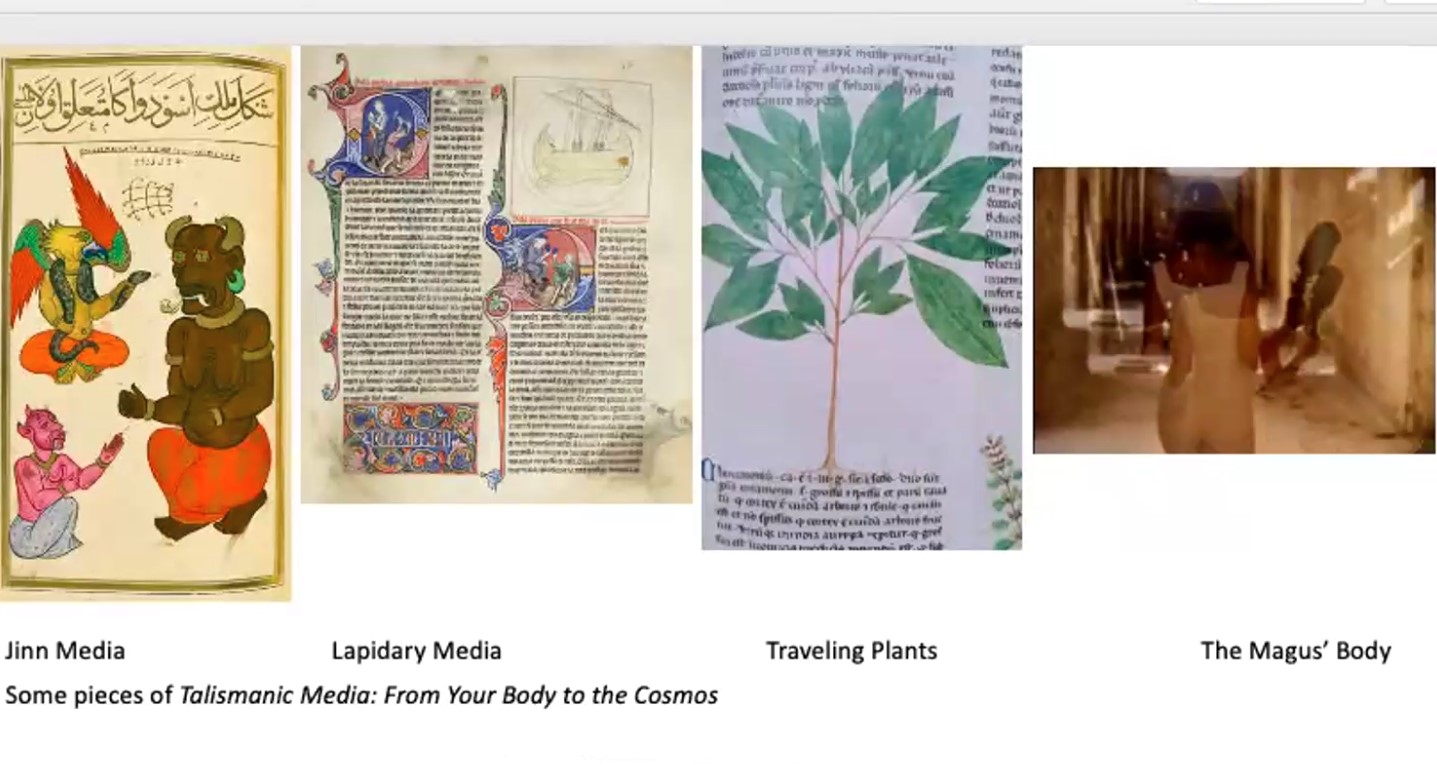
Heartwarming Meeting of August 30, 2025
On August 30, 2025, SMRN held another warm meeting with a group of members, including Mena El Shazly, Niusha Hatefinia, Nezih Erdoğan, Nina Czegledy, Laura Marks, and J.R. Osborn.
During the meeting, J.R. Osborn presented his research, “Arabic Script and Early Printing,” tracing the four-form Arabic script model to Alphabetum Arabicum (1597) and its lasting impact on typography and teaching. Following that, Laura Marks’ presentation, “Jinn as Mediators in Media Theory,” explored jinn in Islamic traditions and proposed them as metaphors for the invisible forces of contemporary media.
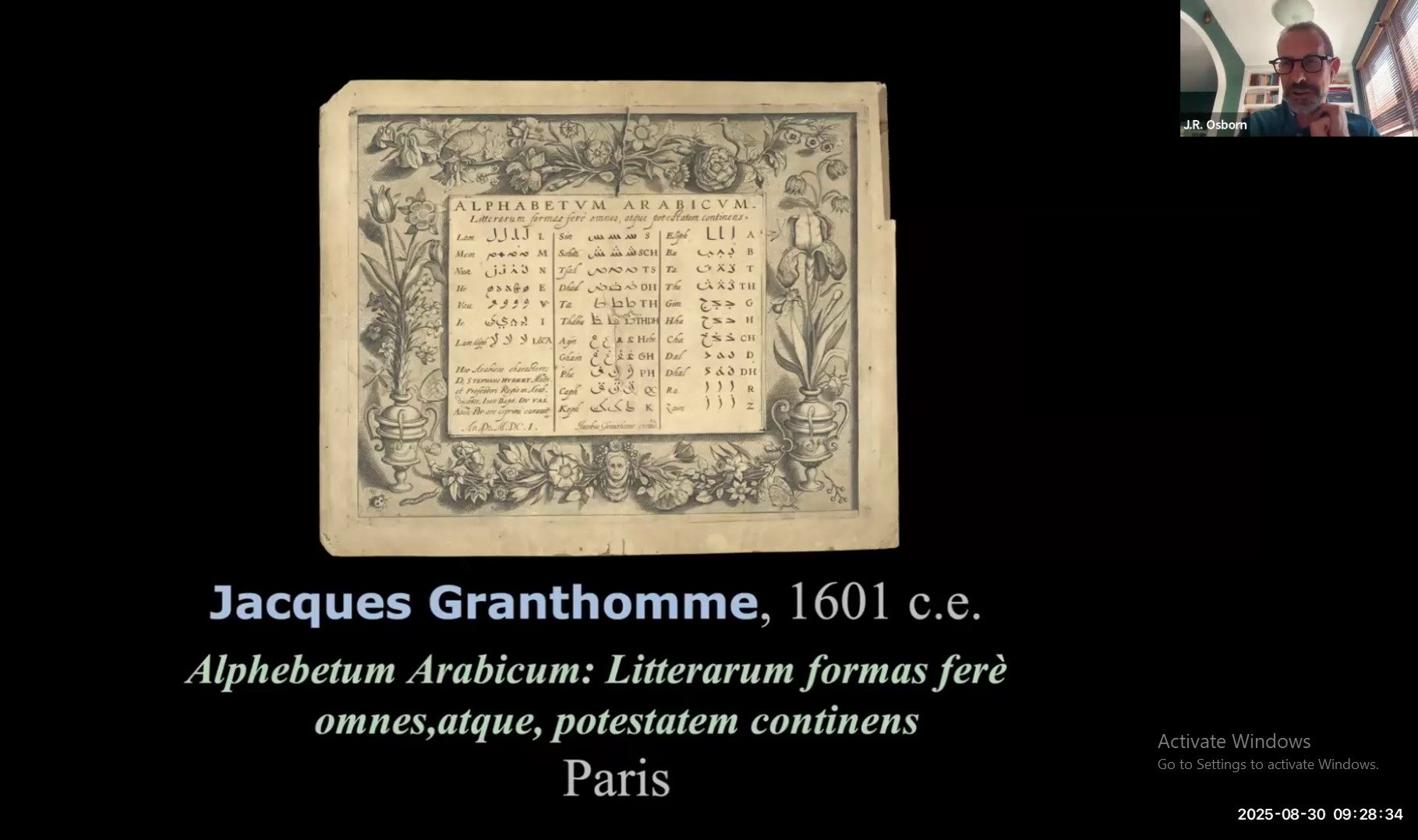
The first presentation, delivered by J.R. Osborn, examined the origins, development, and cultural impact of the “four-form model” of the Arabic script, which presents each letter in isolated, initial, medial, and final forms. This model, now standard in teaching and typesetting Arabic, was not always the norm. J.R. traced the model’s origins to the 1597 publication Alphabetum Arabicum, produced by the Typographia Medicea in Rome, edited by Giovanni Battista Raimondi and printed with Arabic type cut by Robert Granjon. In this 64-page tract, pages 4–7 contain a table that abstracts the cursive flow of Arabic handwriting into distinct, combinatorial forms suitable for movable type, including an “isolated medial” form that does not naturally occur in handwriting.
J.R. argued that this abstraction was a technical innovation that enabled the printing of Arabic script by breaking down the continuous line of handwriting into separate, reproducible shapes. The four-form table in Alphabetum Arabicum may be the first printed occurrence of this model, and it quickly became influential, shaping the production of Arabic type specimen sheets and being widely copied across Europe. This shift was closely tied to the needs of moveable type technology and had lasting ramifications: it simplified and standardized the visual richness of handwritten Arabic, influenced how Arabic is taught, and continues to shape digital encoding protocols for Arabic script today.
The presentation also discussed the broader cultural and technological implications of this standardization, including how print technology influenced the perception and teaching of Arabic script, and how digital typography continues to grapple with these historical legacies. J.R. concluded by inviting discussion on earlier manuscript traditions and the ongoing negotiation between handwritten and printed forms.
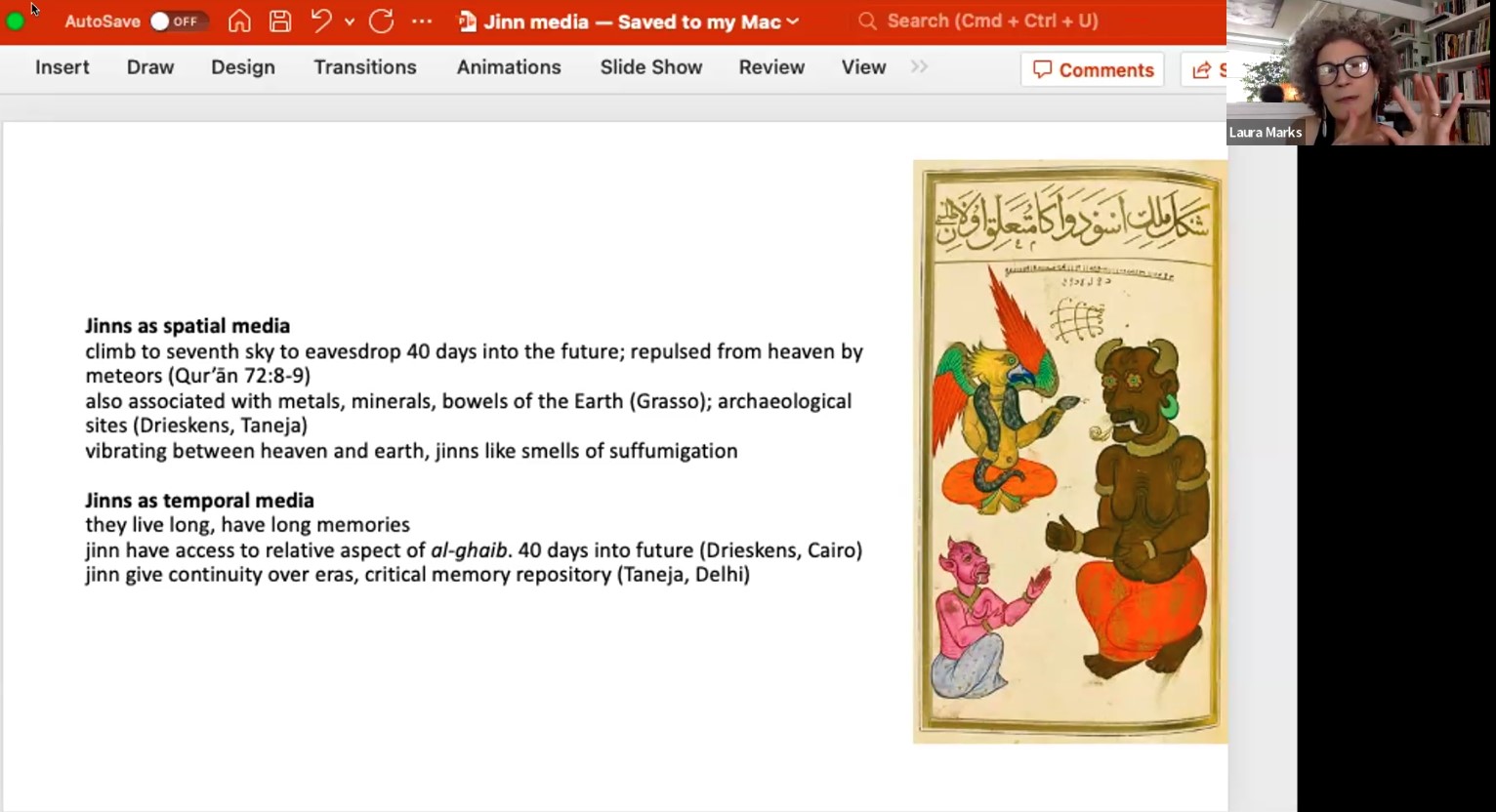
In the last part of our meeting, Laura Marks’ presentation, titled “Jin Media,” explored the concept of jinns as mediators in Islamic and Middle Eastern traditions and their relevance to contemporary media theory. She began by explaining that, according to the Quran and related literature, jinns are rational beings created by God alongside humans, and they serve as intermediaries between the earthly and heavenly realms. Drawing on historical and occult practices, Laura described how magicians and practitioners have long appealed to jinns to carry messages, perform tasks, or access hidden knowledge, positioning jinns as “restless intermediaries” who can travel between worlds and bring back information inaccessible to humans.
Laura connected these historical beliefs to modern media theory by proposing that jinns can be seen as a metaphor for the invisible, affective, and sometimes unpredictable forces that mediate communication and knowledge in the contemporary world. She discussed the idea of the “air” as a conductor full of beings and affects, and how jinns, like media technologies, can disrupt the status quo and challenge established forms of knowledge and power. Laura’s talk emphasized the importance of thinking about mediation not just in technical terms, but also in terms of cultural, spiritual, and affective dimensions, using the figure of the jinn as a critical lens for understanding the complexities of media, communication, and cultural transmission.
Comments