Heartwarming SMRN Meeting of March 30, 2026
On March 30, 2026, SMRN held another warm and engaging meeting with members including Nina Czegledy, Juan Castrillón, Mihai Băcăran, Niusha Hatefinia, and Lynn Kirby.
The meeting began with Juan Castrillón’s presentation on an experimental film titled “Read Letters and Asynchronous Perspectives,” followed by Mihai Băcăran’s presentation, “Traces: Notes on the Limits of Representation.”

Juan Castrillón shared a collaborative audiovisual project with Japanese multimodal anthropologist Pero Fukuda. The project began as an exchange of audiovisual “letters”: rather than explaining their footage to each other, they responded through images and sounds. Juan described this process through the ideas of asynchrony and “multimodal diplomacy.” Drawing on his work with the Cubeo in the Colombian Amazon, he suggested that ethnographic filmmaking does not have to provide a definitive representation or interpretation. Instead, the filmmaker can facilitate connections among images, sounds, memories, dreams, and different voices, leaving room for new meanings to emerge.
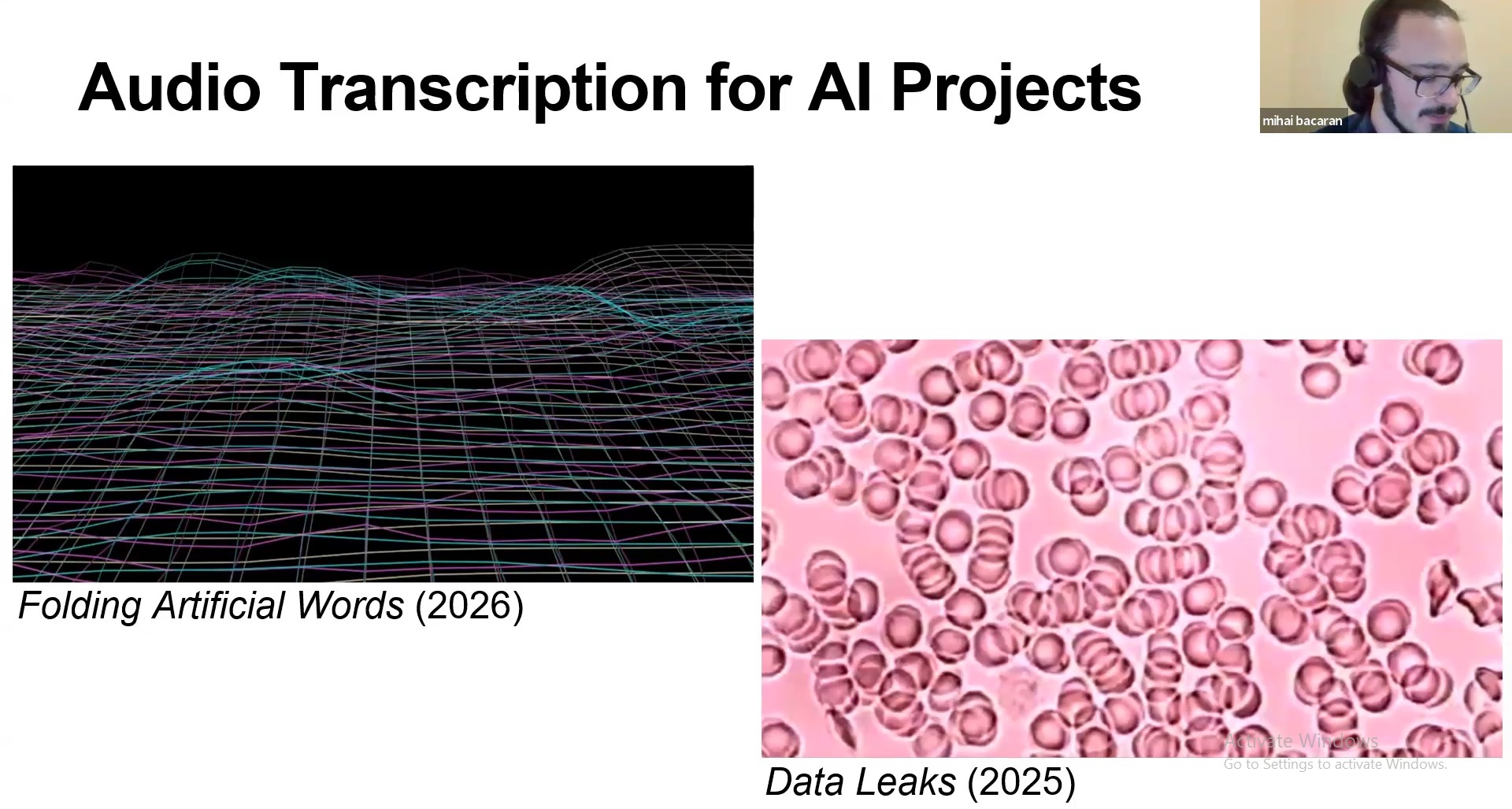
Next Mihai Băcăran continued our discussions of diagrams and diagrammatic thinking with a presentation on traces and the limits of representation. Starting with the exchange between Jacques Derrida and artist Valerio Adami, he explored how images, writing, and other traces can modulate rather than simply represent sense. He connected these ideas to his experimental audiovisual work and to his research on AI audio-transcription labour, including his own experience as a transcriber. Mihai is especially interested in experiences that leave few visible traces, such as what happens in workers’ imaginations, and in how audiovisual practices can create moments of disorientation that open up new possibilities for sense-making.
The two presentations connected nicely around the limits of representation. Juan’s idea of synthesis and Mihai’s idea of modulation both offered ways of thinking about audiovisual practices as opening up relationships and meanings rather than fixing them.
Comments