Illuminating Meeting of January 30, 2026
On January 30, 2026, SMRN held another warm and engaging meeting with members including J.R. Osborn, Farshid Kazemi, Azadeh Emadi, Rafik Patel, Nina Czegledy, Steven Baris, Pantea Karimi, Ahmed Shams, and Laura Marks.
The meeting began with a discussion led by Dr. J.R. Osborn on Allah Transcendent by Ian Richard Netton, followed by Dr. Laura Marks’s presentation, “Lapidary Media.”
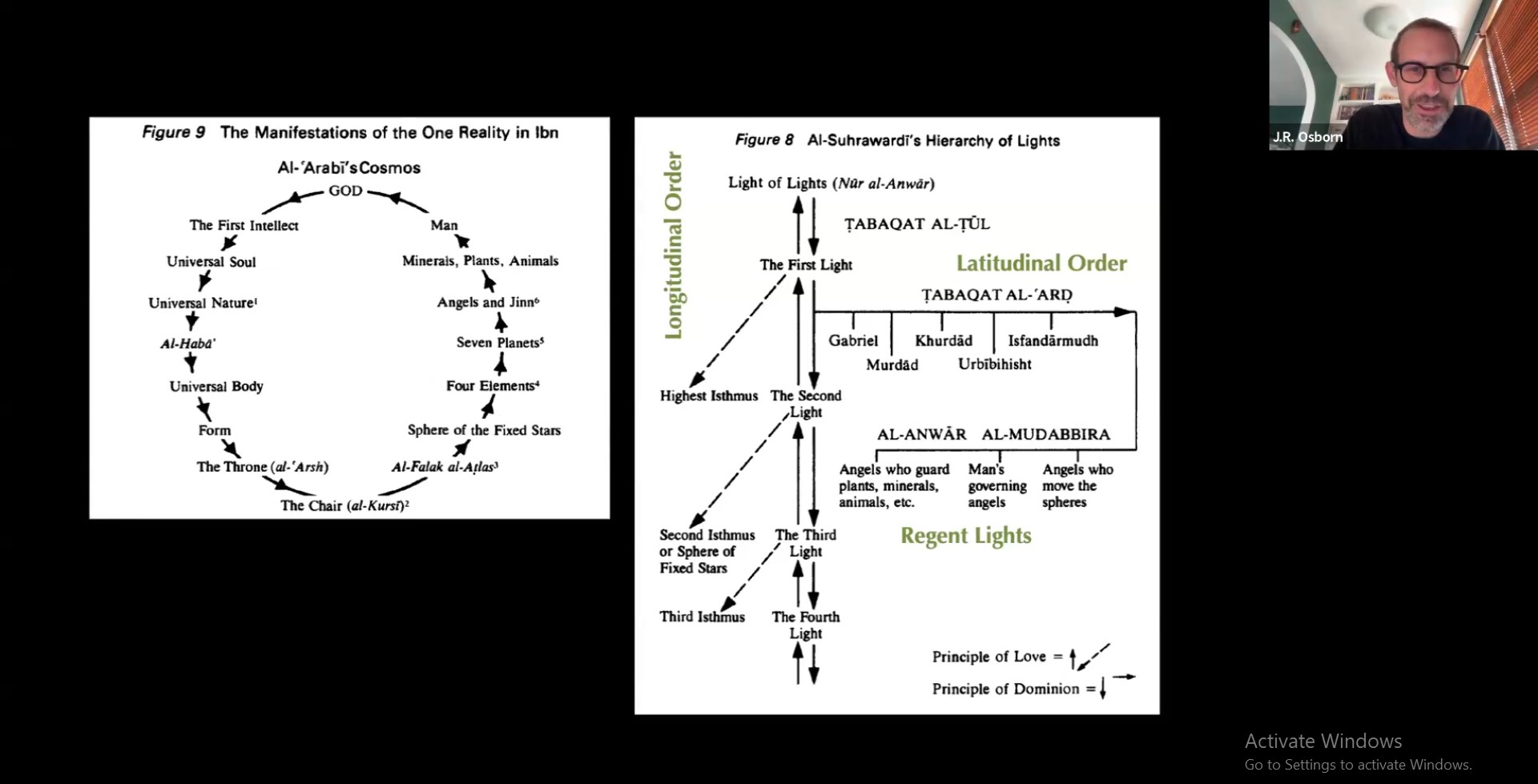
In the first part of the meeting, Dr. Osborn highlighted how Netton’s work uses diagrams not merely as illustrations but as analytical tools for mapping Islamic cosmologies and their semiotic structures. Netton frames both Suhrawardi and Ibn Arabi as developing distinct paradigms from the Qur’anic “creator model.” Suhrawardi’s system emerges as a highly complex, “Baroque” hierarchy of lights, combining Neoplatonic emanation with angelic orders, Zoroastrian elements, and intermediary realms (barzakh). This produces a dense, multi-layered semiotic structure in which each level carries specific meaning and function, shaped by both “dominion” (emanation) and “love.”
In contrast, Ibn Arabi’s diagram presents a circular cosmology that is simpler in form but conceptually more radical, emphasizing unity, return, and the idea that all existence is a “shadow” of the divine. The discussion linked this to a more fluid notion of semiosis, comparable to Jacques Derrida’s idea of endless signification, where meaning constantly defers and returns to the One. A key focus was the concept of barzakh as both boundary and mediating realm—an imaginal space that connects material and spiritual worlds. Overall, the conversation underscored Netton’s broader insight: that these Islamic cosmological systems already contain forms of complexity, semiotics, and philosophical thinking often associated with modern theory.
In the final part of the meeting, Dr. Marks introduced her emerging concept of “lapidary media,” part of a larger project on talismanic media. Focusing on medieval lapidaries, especially the Lapidary of Alfonso X, she explored how stones were understood within a cosmological system linking earthly minerals to celestial forces. Each stone corresponds to a specific degree of the heavens and carries distinct properties (healing, magical, erotic, or protective), activated when its governing star is in the ascendant. Drawing on thinkers like Al-Kindi, she connected this framework to a theory of ray-based causality, relating it to earlier discussions of illuminationist philosophy and gradations of light. At the same time, she emphasized the richness and strangeness of these stones, many of which remain obscure or possibly fictional, while noting occasional continuities with modern science.
The discussion then turned to how such an enchanted cosmology might be rethought within contemporary media theory. Laura proposed moving away from extractive, industrial uses of minerals toward a more relational and non-dominative understanding of matter, inspired by thinkers such as Gilbert Simondon and Gilles Deleuze. She suggested that media could be understood as forms of cosmic correspondence or “co-modulation,” where each material entity expresses the universe from its own perspective. The conversation also engaged themes of hermetic knowledge, the authority of esoteric traditions, and the imaginative—sometimes fictional—dimension of lapidaries, while reflecting on parallels with alchemy and the symbolic role of minerals as mediators between the earthly and the cosmic.
Comments