Inaugural Meeting Held Successfully
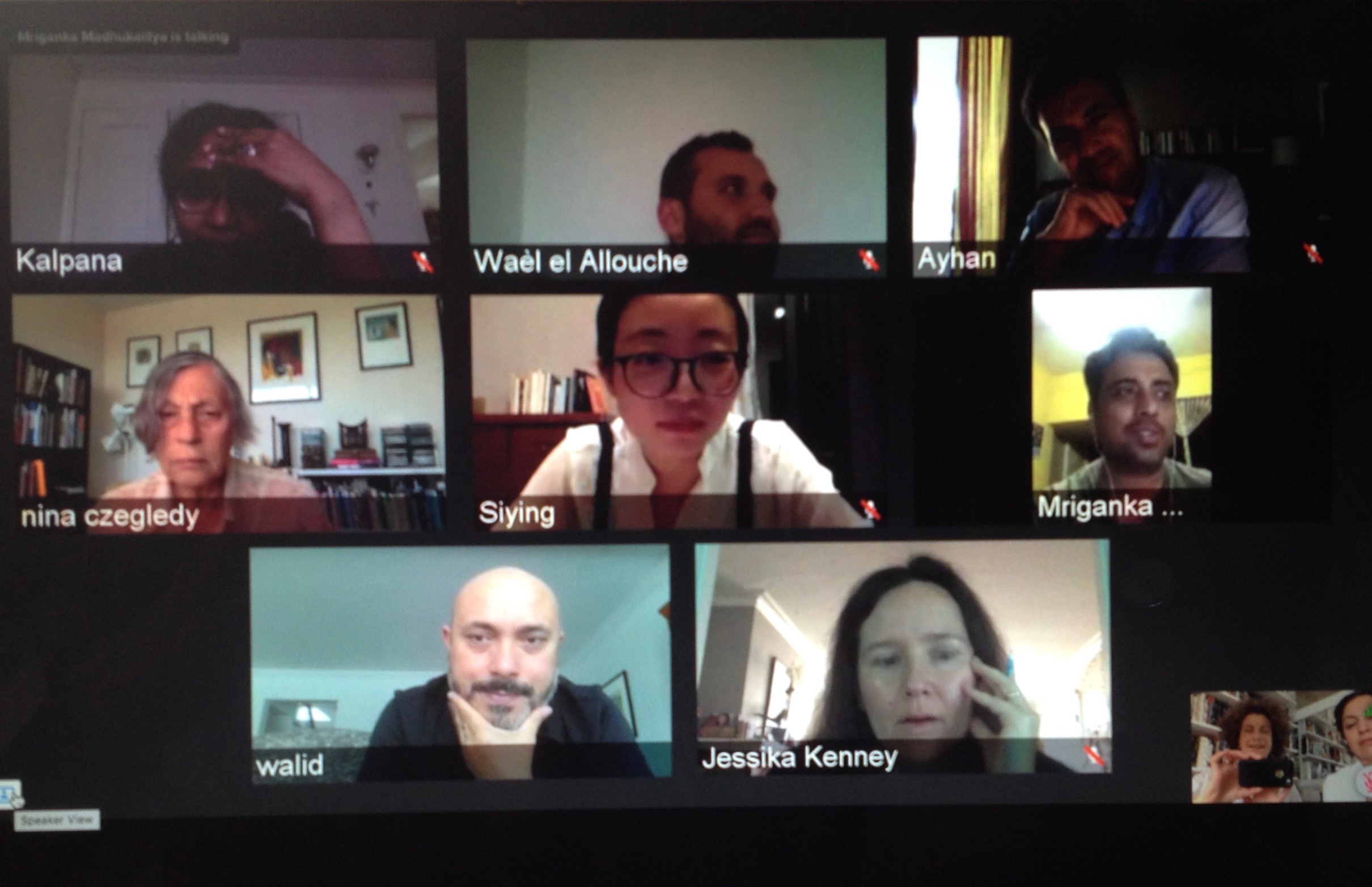
SMRN’s first monthly meeting was held successfully via the video conferencing platform BlueJean on May 24, 2018. 14 members attended the meeting including Ayhan Ates, Azadeh Emadi, Halil Atasever, Haytham Nawar, Jessica Kenney, Kalpana Subramanian, Laura Marks, Mansoor Behnam, Mriganka Madhukaillya, Narjis Mirza Nina Czegledy, Siying Duan, Wael el Allouche and Walid El Khachab. These members are attending from many different parts of the world.
The meeting started with a brief introduction from every attendee of their work and ideas. There can be seen many meeting points between people’s interests as well as different perspectives grounded in their respective culture.
It then followed by an introduction of the idea of SMRN, procedures, and plans by Laura Marks and Azadeh Emadi. The main points include the purpose of the network, website functions, practical details of the monthly meetings, Intellectual property, and confidentiality and Long-term goals.
After this introduction, Laura presented her work in progress on the deep history of arts of the secret: talismans, emblems, encrypted images, “operative images.” Termed in Arabic bātiniyya, the tradition of the search for inner secrets was most highly developed in Isma‘ili Shi‘a thought. It understands the cosmos to be an interconnected whole. Therefore, it is possible for adepts to carry out operations on the cosmos: operations using talismans (e.g. Al-Buni, Al-Tusi), astrology, and magic. The knowledge of these practices generated power for its adepts, as long as they remained secret: hence taqiyya or dissimulation. Through translations of works like the 10th C Rasa’il Ikhwan al-Safa’, the Shi‘a theory of the secret informed European Renaissance esoteric practices. It then traveled, in concealment, into modern Western philosophy and art. Contemporary works include SMRN member Navine G. Khan-Dossos’ The Black Standard (2016) and Hasan Elahi, “Tracking Transience” (ongoing).
Next, Azadeh presented her work in progress on Pixel Picker, software that she collaboratively developed for her research on video’s materiality and the pixel’s “point of view.” The paper introduces some of the concepts that informed the production of Pixel Picker; Azadeh is also hoping to find ways to make it appropriate to other artists and video makers. Her long-term plan is to develop the software for other artists to use in their creative process.
Comments