Inspiring Meeting of June 30, 2025
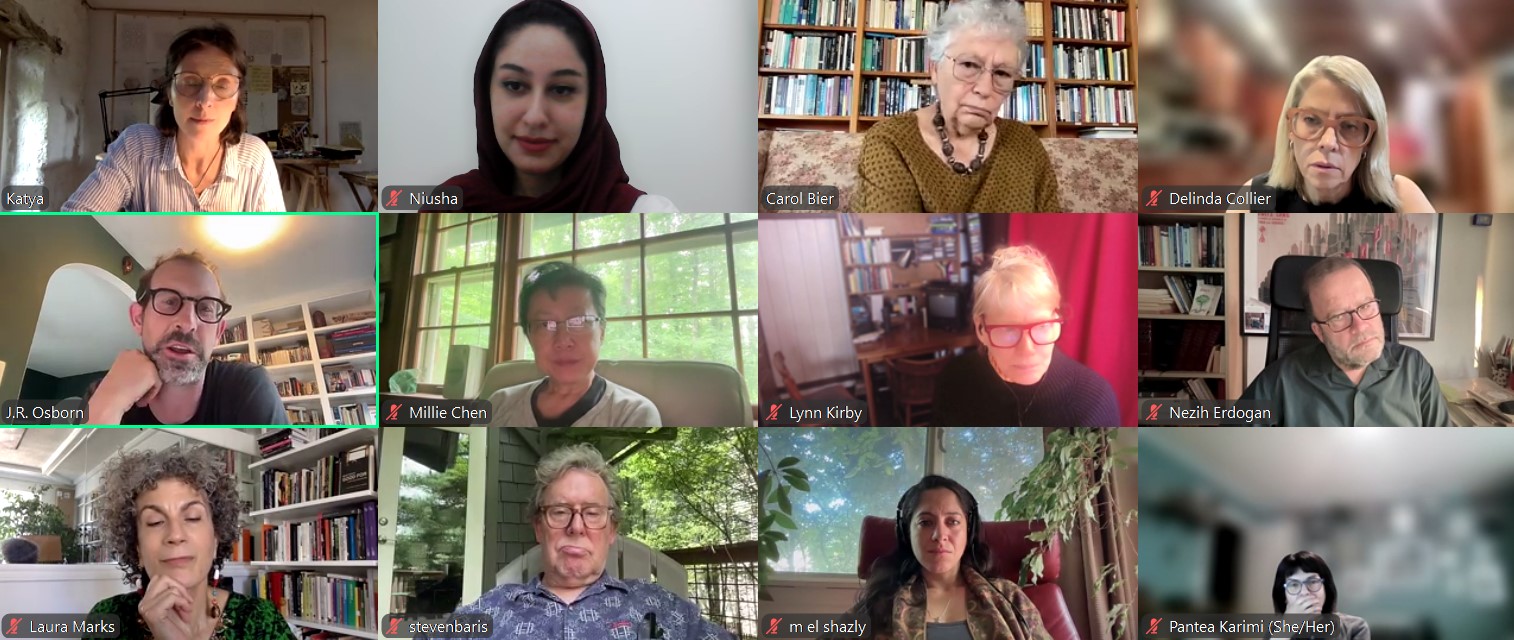
On June 30, 2025, SMRN held another warm meeting with a wonderful group of members, including Carol Bier, J.R. Osborn, Millie Chen, Lynn M. Kirby, Nezih Erdogan, Katya Nosyreva, Laura Marks, Niusha Hatefinia, Steven Baris, Mena El Shazly, and Pantea Karimi.
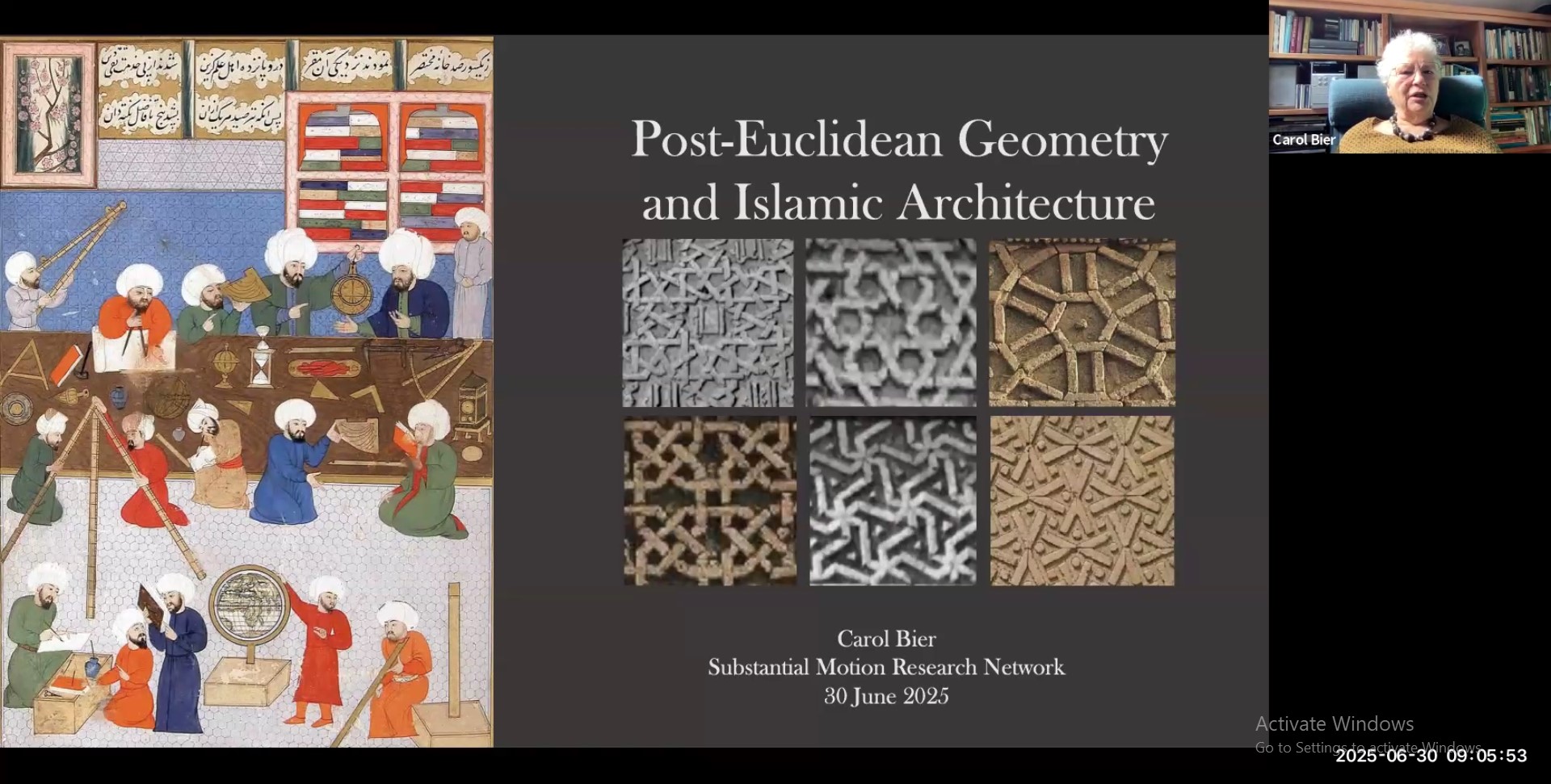
The meeting opened with our friend Carol Bier's presentation, which focused on Post-Euclidean geometry in Islamic art, specifically examining the Kharraqan tomb towers from the late 11th century in north-central Iran. She introduced the concept through an image of the Taqi al-Din astronomical observatory from 1581, which demonstrated a non-linear perspective rendering of space.
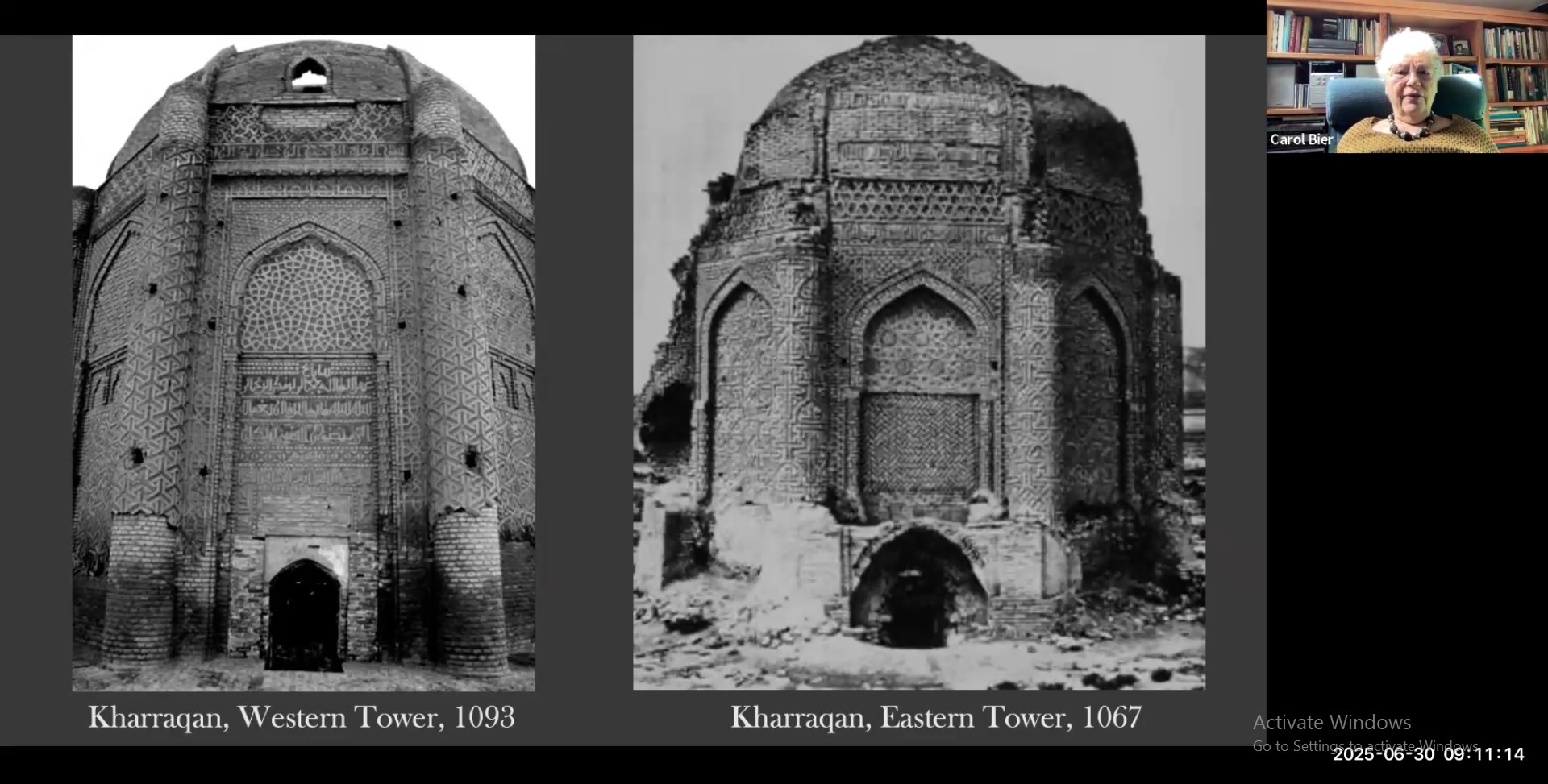
The two octagonal towers, an eastern and western tower, were her primary case study. Both were built of brick and covered in intricate geometric patterns. The eastern tower, dated 460 Hijri, was constructed first and featured approximately 30 geometric patterns, while the western tower, built 26 lunar years later, had over 70 patterns.
Carol analyzed the geometric designs, highlighting their complexity. She discussed how the patterns incorporated intersecting polygons like dodecagons, hexagons, and pentagons, with various symmetries including rotational, reflectional, and glide reflection. The tympanum of each tower featured particularly extraordinary patterns, with the eastern tower's tympanum containing the name of God (Allah) within its geometric structure.
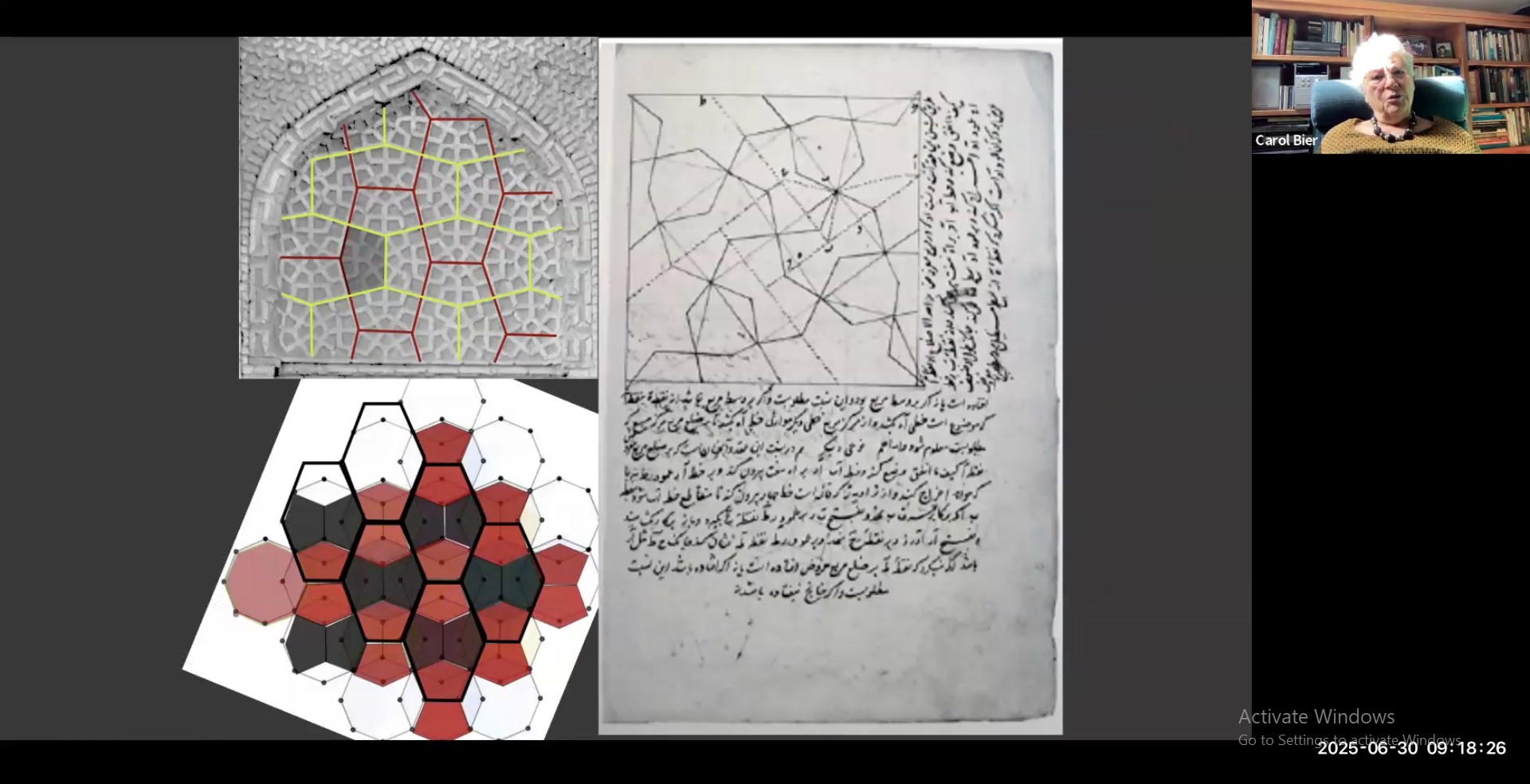
She connected these geometric patterns to philosophical and spiritual concepts, referencing Plato's Timaeus and the Epistles of the Brethren of Purity. Her key argument was that these designs represent a "Post-Euclidean" approach to geometry, extending beyond Euclid's limited line segments to explore the plane as an infinite, conceptualized space.
The presentation also touched on the relationship between geometry, numbers, and spiritual symbolism, suggesting that the patterns reflect deeper philosophical and cosmological understanding.
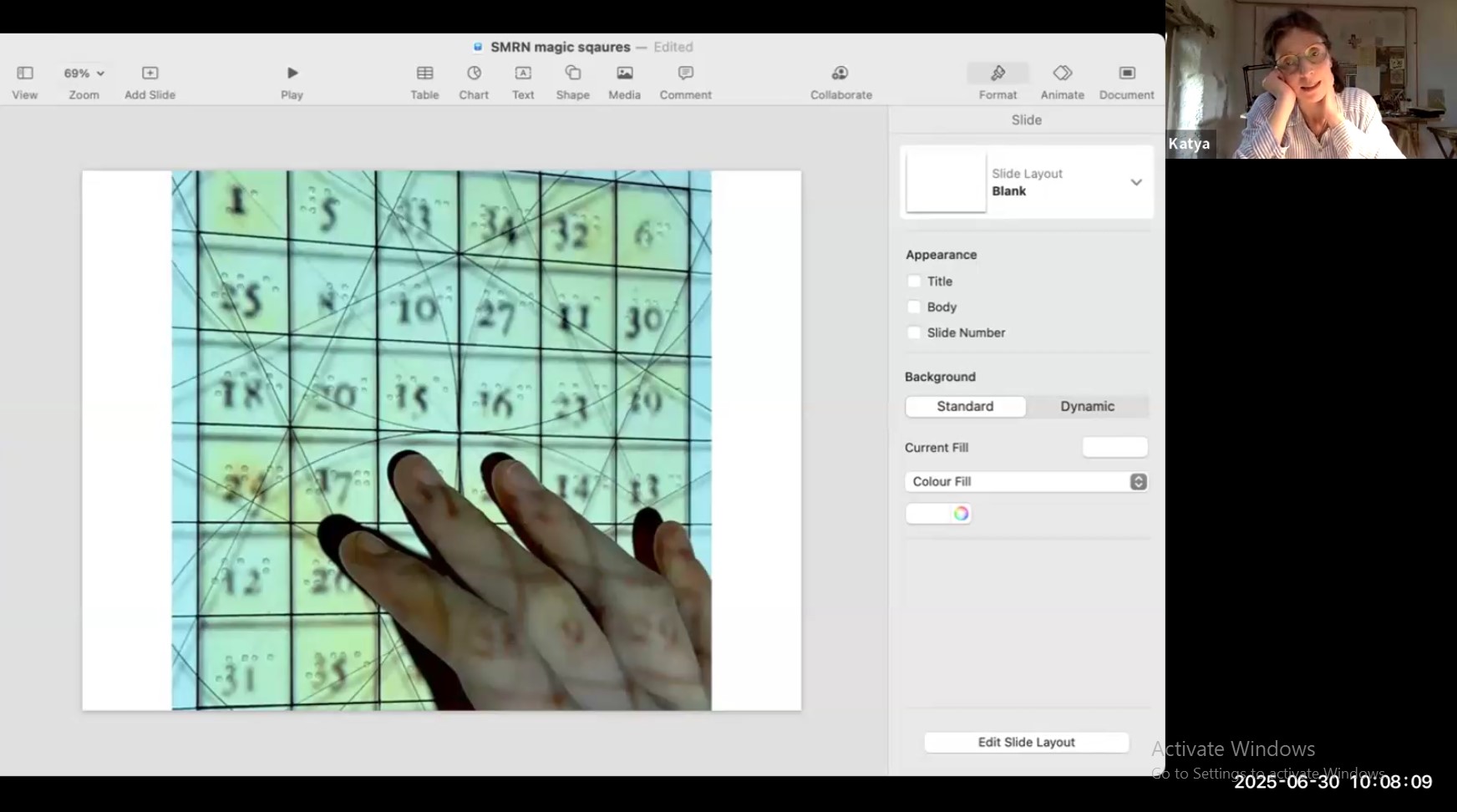
In the second part of the meeting, Katya Nosyreva presented her research on magic squares in Islamic mathematical and cultural traditions, tracing their historical development and philosophical significance. She opened her talk by defining magic squares as grid-based numerical arrangements in which the rows, columns, and diagonals all sum to the same number.
Her presentation covered the historical origins of magic squares, noting early examples from China and their transmission to the Islamic world. She highlighted mathematical texts by scholars like Abu Wafa Buzjani, who provided detailed construction methods for magic squares. The Brethren of Purity (Ikhwan al-Safa) also wrote extensively about magic squares, emphasizing their spiritual and mathematical properties.
A significant part of Katya's presentation focused on her artistic exploration of magic squares. She created Braille magic squares as part of a project investigating touch and accessibility, using handmade pigments and working with partially sighted individuals. Her work included color-coded squares inspired by planetary associations and experimental projections that blurred the boundaries between visual and tactile experiences.
She also examined the talismanic qualities of magic squares, showing historical examples like battle shirts inscribed with magical numerical patterns. The presentation emphasized the interconnection between numbers, letters, and spiritual concepts in Islamic mathematical thought, demonstrating how magic squares were more than just mathematical curiosities but complex cultural and philosophical artifacts.
Comments