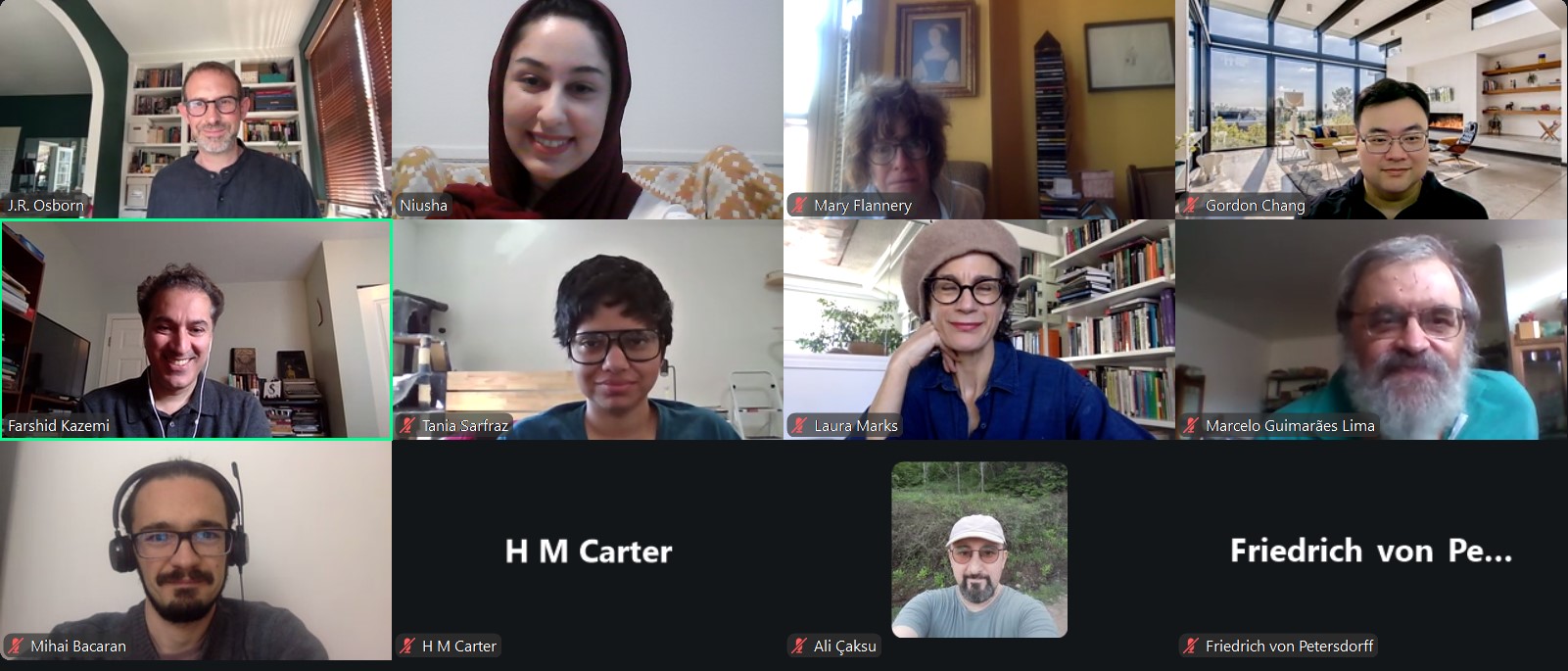
SMRN’s Thought-Provoking Public Lecture
On March 21, 2026, SMRN hosted another fascinating public lecture, Derrida and the Diagram, presented by Dr. J. R. Osborn, followed by a discussion with Dr. Farshid Kazemi.
Dr. Osborn’s lecture examined the relationship between Jacques Derrida’s philosophy, particularly Of Grammatology, and the concept of diagrams as forms of writing and thinking. Although Derrida famously claims he has “no diagram,” Osborn argued that his work implicitly engages diagrammatic logic through ideas such as spacing, non-linearity, and the instability of meaning. While the term “diagram” appears only rarely in Derrida’s texts, often as a translation of “schema,” it nevertheless frames key arguments, including the critique of the hierarchy between speech and writing and the understanding of writing as spatial rather than purely temporal. The lecture also highlighted how Derrida’s concept of the “trace” and his challenge to fixed origins point toward a diagrammatic understanding of meaning as relational and distributed.
The talk further explored moments where Derrida employs diagrammatic or proto-diagrammatic forms, such as layered writing, crossed-out words, and experimental formats like Glas, which disrupt linear reading through columns and spatial arrangement. These practices demonstrate how meaning can emerge through visual and structural relations rather than sequential logic. The discussion of Rousseau’s “impossible diagram” underscored Derrida’s critique of linear history, proposing instead that meaning and history are multi-linear, recursive, and without a clear origin.
In conclusion, the lecture suggested that while Derrida does not offer a direct theory of diagrams, his work provides conceptual tools for developing a diagrammatic mode of thinking. By emphasizing spacing, multiplicity, and the “between” (différance), Derrida opens the possibility of using diagrams not merely as representations, but as active, generative forms of thought that challenge conventional writing and enable new ways of understanding.
Comments